How to Size a Motor for Inspection, Delivery and Cleaning Robots
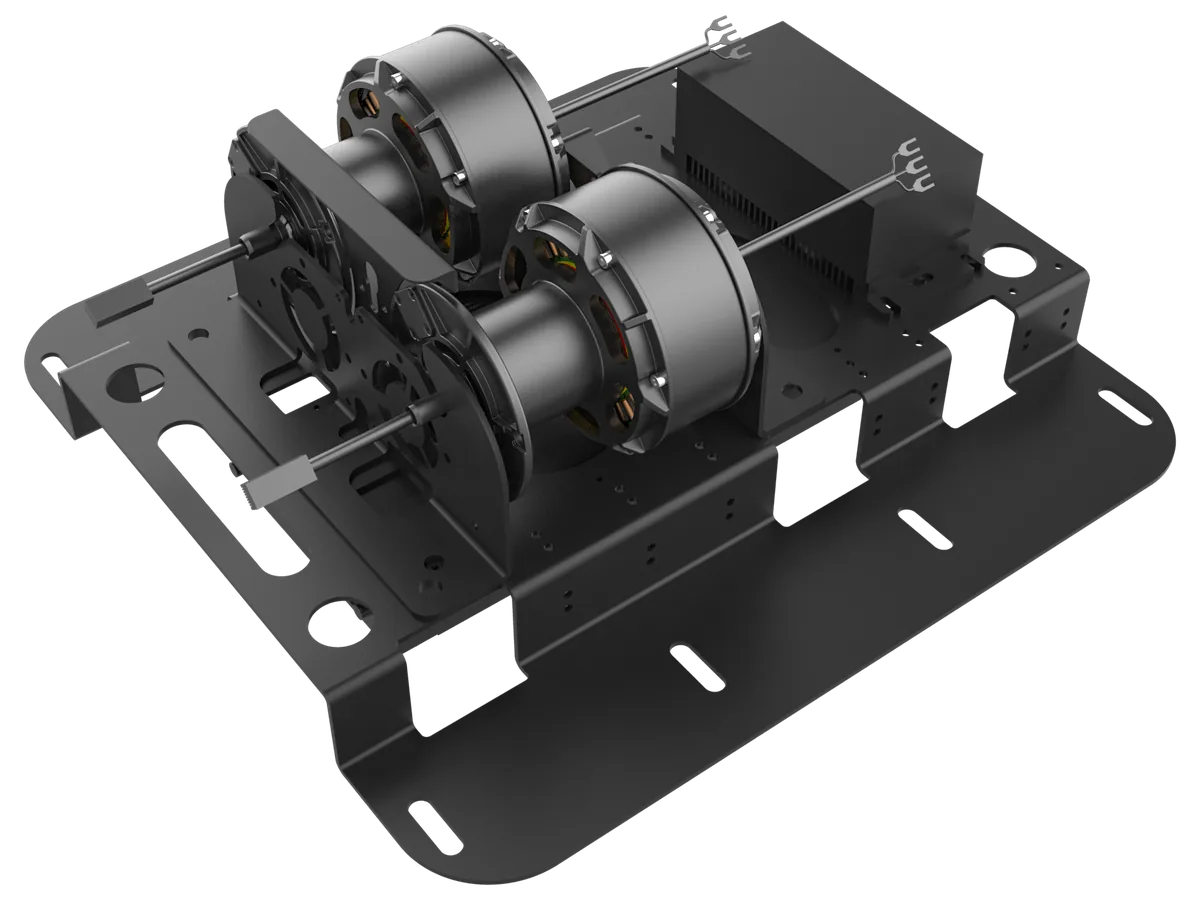
Choosing the right motor for inspection, delivery, and cleaning robots requires matching torque, speed, load capacity, and operating time. A typical mobile robot with a 50–150 kg total weight may need 5–30 Nm wheel torque depending on wheel size, terrain, and climbing requirements. Motors should be selected according to real operating conditions, including acceleration cycles, payload changes, and duty time. A correctly sized motor improves battery efficiency, reduces heat generation, and supports longer service life.
Mobile robots used in warehouses, hospitals, airports, and commercial buildings depend on accurate motion control. The motor system determines how smoothly the robot starts, stops, turns, and handles different surfaces. According to industry reports from 2024, autonomous mobile robots continue expanding in logistics and facility services, with many platforms operating for 8–12 hours per day on battery power.
Motor sizing begins with the total moving mass. Engineers must include the robot frame, battery pack, sensors, controllers, payload, and additional equipment. A delivery robot carrying 30 kg of goods may require significantly higher torque than an inspection robot with the same chassis size.
The required wheel torque is mainly affected by vehicle weight, wheel radius, rolling resistance, slope angle, and acceleration requirements. A small change in any of these parameters can increase motor requirements by 20% or more.
The first calculation involves the forces acting against movement. A robot traveling on a flat indoor floor mainly overcomes rolling resistance, while outdoor inspection robots must also handle uneven ground and slopes.
Typical resistance sources include:
| Factor | Effect on Motor Selection |
|---|---|
| Robot weight | Higher weight increases required torque |
| Wheel diameter | Larger wheels require more torque but improve obstacle clearance |
| Floor condition | Carpet and rough surfaces increase resistance |
| Slope angle | Climbing requires additional continuous torque |
| Acceleration | Short-term torque demand increases during startup |
Rolling resistance varies by surface type. Smooth concrete floors may have a coefficient near 0.01–0.03, while industrial carpets can reach 0.05–0.10. A cleaning robot moving from a polished floor to a carpet area may therefore require approximately 30–50% more driving torque.
After calculating resistance forces, engineers evaluate speed requirements. Inspection robots often operate at lower speeds, commonly between 0.3 and 1.5 m/s, because cameras, thermal sensors, and scanning systems require stable movement. Delivery robots may operate faster, with some commercial systems reaching 2 m/s or above in controlled environments.
The relationship between speed and torque determines the motor operating point. High torque is needed during acceleration and climbing, while higher rotational speed is required during normal travel.
A suitable motor should provide:
-
Enough continuous torque for normal operation
-
Additional torque capacity for starting and climbing
-
Stable speed control at low velocity
-
Efficient operation within the battery voltage range
For autonomous robots, continuous torque is often more important than maximum torque. A motor that can briefly produce high output but cannot remove heat during long operation may reduce reliability. Many professional robot systems operate with motors designed for continuous duty cycles exceeding 60 minutes without interruption.
Gearboxes are commonly used to adapt motor speed and torque. A motor may rotate at several thousand RPM, while robot wheels typically require much lower speeds. Planetary gearboxes are widely used because they provide high torque density and mechanical efficiency, often above 90%.
The gear ratio must balance travel speed and wheel force. A higher reduction ratio increases available wheel torque but reduces maximum speed. A lower ratio allows faster movement but requires a stronger motor.
For industrial mobile robots, AGV direct drive motors are increasingly used because they combine motor and wheel drive functions into a compact structure. This design reduces mechanical transmission components, improves installation efficiency, and can simplify maintenance compared with traditional motor-plus-chain or belt systems.
Motor selection also depends on the robot application. Inspection robots, delivery robots, and cleaning robots have different operating patterns.
| Robot Application | Typical Motor Requirements |
|---|---|
| Inspection robots | Smooth low-speed control, long operation time, precise movement |
| Delivery robots | Higher torque, frequent acceleration, payload handling |
| Cleaning robots | Continuous operation, energy efficiency, stable output |
Inspection robots usually prioritize motion stability. When carrying cameras, LiDAR, or ultrasonic sensors, vibration must be controlled because mechanical vibration can affect measurement accuracy. Brushless DC motors with encoders are commonly selected because they provide accurate speed feedback and low maintenance requirements.
Delivery robots require stronger acceleration performance because they frequently stop and restart. In a warehouse or hospital environment, a robot may complete hundreds of acceleration cycles per day. Repeated startup conditions require motors that can handle short-term torque increases without excessive current consumption.
Cleaning robots place more emphasis on long operating periods. Vacuum systems, brushes, water tanks, and cleaning attachments increase mechanical resistance. A commercial cleaning robot operating for 6–10 hours per shift requires motors with stable thermal performance and high efficiency.
Battery voltage is another factor affecting motor selection. Small indoor robots commonly use 12 V or 24 V systems, while larger autonomous mobile robots often use 36 V or 48 V battery architectures. Higher voltage systems reduce current demand at the same power level, helping reduce cable losses and improve energy efficiency.
For example, a 500 W motor operating at 24 V requires more than 20 A current, while a 48 V system requires roughly half that current. Lower current levels can reduce heat generation in wiring and motor controllers.
Thermal analysis should be performed before finalizing the motor model. Motor temperature depends on current, operating time, ambient temperature, cooling design, and installation space. In industrial environments, ambient temperatures may reach 35–45°C, reducing the available cooling margin.
Engineers usually add a safety margin when selecting motors. A motor operating exactly at its calculated limit may struggle when conditions change, such as heavier payloads, battery aging, dirty wheels, or uneven surfaces.
Common design margins include:
| Design Parameter | Recommended Consideration |
|---|---|
| Continuous torque | 20–40% reserve capacity |
| Maximum current | Controller and battery limits |
| Thermal capacity | Long-duration operating temperature |
| Mechanical strength | Gearbox and wheel durability |
Encoder selection also affects robot performance. Low-resolution feedback may cause unstable speed control, especially at slow movement speeds. High-resolution encoders allow precise wheel control, improving navigation accuracy and reducing unnecessary motor corrections.
The motor controller must also match the motor characteristics. Parameters such as rated voltage, current limit, communication protocol, and control mode should be considered together. A well-matched controller can improve efficiency by controlling acceleration, braking, and regenerative functions.
Motor sizing for autonomous robots is therefore a combination of mechanical calculation, electrical design, and application requirements. By evaluating weight, speed, torque, gearbox ratio, battery system, thermal conditions, and operating environment, engineers can select motors that provide reliable movement for inspection, delivery, and cleaning tasks across different industries.